

President Joe Biden has the opportunity to continue and accelerate progress on America's proud return to the Moon and beginning the journey to Mars.
In fact, during his term, with just a few extra bucks and following the roadmap already prepared under President Trump and NASA Administrator Jim Bridenstine, Biden could actually preside over the launch of the first woman and next man to set foot on the Moon.
Or he could give in to the anti-science and anti-American leadership elements and delay perhaps forever our return--and then we would become mere spectators to China's triumphant landings and expected illegal territorial claims on the Moon.
That is the choice, and the decisions made this year will decide the fate of American, free-world and commercial access to the Moon and beyond for decades to come. Those are factually the stakes.
Since the president's election, space industries, policy experts and commercial ventures have been hoping for a positive signal from the new administration that they will not outright cancel America's return to the Moon, or not delay it so long that China can complete their anti-access strategy to achieve their intended dominance of space.
This is not a trivial matter. The entire future exploration and habitation of the Moon depends upon free access to water-ice craters on the poles, free access to cis-lunar space, and the ability to establish landing sites, habitats and eventually colonies.
China recognizes no sovereignty but their own, as evidenced by claiming and militarizing the South China Sea against 400 years of freedom of the seas and invading the sovereign territories of many nations.
Don't get it? Consider this 2017 shot across the bow by Ye Peijian, the head of the Chinese Lunar Exploration Program: “The universe is like the ocean, the moon is like the Diaoyu Islands and Mars is like Huangyan Island.” Diaoyu is the CCP's name for Japan’s sovereign Senkaku Islands, and Huangyan is actually Scarborough Shoal which belongs to the Philippines.
You read that right, China is openly declaring they will claim and militarize the Moon, and deny open access to the free world and commercial ventures.
China often obscures their intentions to lull the west to sleep, but here the Communist leadership was being honest and threatening, perhaps to bully the U.S. and free world into submission. America left a plaque on the Moon proclaiming, "we came in peace for all mankind," but China does not share in a desire for peace or for "all mankind."
In our absence, China will make territorial claims on the Moon and eventually Mars. If we abandon and destroy the International Space Station--America's national presence in orbit, expect China to make good their threat to claim "vertical sovereignty" which means all space above Chinese territory--essentially all orbital space.
A Chinese-dominated moon might allow foreigners and commercial ventures IF they obey rules similar to their WTO-violating rules to share their high technology, have a 51% Chinese partner, and never say a bad word about China's regime. That would end U.S. NASA and commercial leadership in space technology.
Therefore, let's look at targets to watch during the next four years:
But they ignored the evidence hiding in plain sight. China may have apparently moved slowly over the past decade, but they were building their infrastructure, building new generations of rockets and spacecraft--and we are now in the early stages of their Apollo-scale 'breakout' to dominate space in all realms.
Witness:

Unlike the U.S., Europe and other free nations, there are no budget constraints in China's military-led space program. None. It is not a civilian but a military program.
China publicly claims that they will not attempt a crewed landing on the Moon before the late 2020s or early 2030s. This is typical Chinese strategic deception. When you look at the elements that are already coming together--spacecraft, launch facilities, rocket factories, robotic lunar landers, 2025 would be more realistic. In fact, China's lunar program revealed presentations that show landings in the 2025 timeframe. Here's one showing the start of a crewed lunar research base on the Moon in the 2025 timeframe.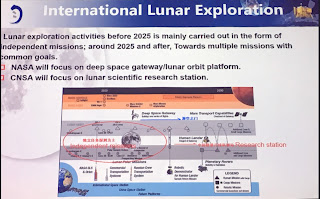
Chinese Lunar Timeline
America's future in space can be wonderful and help propel our economy, jobs and technology to new heights. If decisions made by President Biden this year don't abandon existing progress and cede the high frontier to China.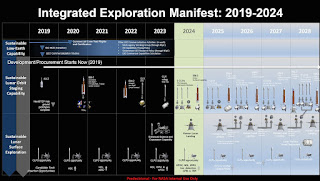
Artemis Missions to the Moon
What should you do to help retain American and commercial leadership in space?
China often obscures their intentions to lull the west to sleep, but here the Communist leadership was being honest and threatening, perhaps to bully the U.S. and free world into submission. America left a plaque on the Moon proclaiming, "we came in peace for all mankind," but China does not share in a desire for peace or for "all mankind."
In our absence, China will make territorial claims on the Moon and eventually Mars. If we abandon and destroy the International Space Station--America's national presence in orbit, expect China to make good their threat to claim "vertical sovereignty" which means all space above Chinese territory--essentially all orbital space.
A Chinese-dominated moon might allow foreigners and commercial ventures IF they obey rules similar to their WTO-violating rules to share their high technology, have a 51% Chinese partner, and never say a bad word about China's regime. That would end U.S. NASA and commercial leadership in space technology.
Therefore, let's look at targets to watch during the next four years:
- Read the president's budget request for NASA. If we see cuts to Artemis and the lunar lander, and shifting funds instead to yet more climate change studies, we will know returning to the Moon is being effectively cancelled by delaying it forever. This may be the first real clue to the administrations intentions. Rhetoric is meaningless or a diversion to not look at real actions by the administration.
- If Artemis I, the un-crewed mission around the Moon, doesn't launch late this year or next year at the latest, that's a signal the return to the Moon is again on the cancellation or forever-delay list--and China wins.
- If Artemis II, the first crewed mission beyond low Earth orbit in almost 50 years, is delayed beyond 2023 or 2024 at the latest, China wins.
- If Artemis III, America's exciting return to the surface of the Moon is delayed beyond 2024 or 2025, China wins.
But they ignored the evidence hiding in plain sight. China may have apparently moved slowly over the past decade, but they were building their infrastructure, building new generations of rockets and spacecraft--and we are now in the early stages of their Apollo-scale 'breakout' to dominate space in all realms.
Witness:
- China has built a huge launch complex, Wenchang Launch Center on Hainan Island, which rivals the Kennedy Space Center and Cape Canaveral. It will even have a theme park and a "space city." This is where high-visibility launches will take place.
- China's SLS/Starship-class rocket, the Long March-9, is under construction, and unlike SLS, has not been constrained by bureaucracy and politics. Similar progress continues on lunar landers and other elements for a crewed landing in the near future.
- China has test-launched their new, indigenous, deep space (Orion-class) crewed spacecraft. This is what will carry their astronauts to the Moon, Mars and beyond.
- China is building reusable rockets, looking like smaller clones of SpaceX's Falcon-9, and it is not hard to imagine they would already have stolen the plans for SpaceX's Starship. Imagine the advantages of being able to land hundreds of troops anywhere on Earth within an hour.
- China is planning a similar spacecraft to NASA’s abandoned X-30 National Aerospace Plane. The airplane/spacecraft would be able to takeoff and land on regular runways anywhere in the world, unlike SpaceX's Starship which is tethered to remote launch or landing stations. Aerospace planes will eventually become the standard for reusable spacecraft.
- China has had five successful robotic missions to the Moon. The latest one, Chang'e 5, returned lunar soil samples to China, and the next is planned to return lunar ice from the south pole.
- China will launch the first module of their permanent military-run space station this year, and perhaps have one or two crewed missions as well this year, followed by routine ISS-like missions. Whenever ISS may be decommissioned, China may have the only crewed national presence in orbit, and a military presence at that, which is a danger to all free-world nations and commercial ventures.
- Long-term plans exist for orbital solar satellites that would beam megawatts and eventually gigawatts of power to China. Like everything China does with technology, there's always a military side. The same beam that could send a gigawatt of energy to receiving stations could instead be directed to destroy foreign cities or military assets, as well as foreign satellites.
- Another plan is in development for a tremendous military radar array on the Moon that could map most military assets on Earth every 24 hours, compared to the small swatches captured from orbital spy satellites.

Chinese Lunar Military Radar Concept
China publicly claims that they will not attempt a crewed landing on the Moon before the late 2020s or early 2030s. This is typical Chinese strategic deception. When you look at the elements that are already coming together--spacecraft, launch facilities, rocket factories, robotic lunar landers, 2025 would be more realistic. In fact, China's lunar program revealed presentations that show landings in the 2025 timeframe. Here's one showing the start of a crewed lunar research base on the Moon in the 2025 timeframe.

Chinese Lunar Timeline
America's future in space can be wonderful and help propel our economy, jobs and technology to new heights. If decisions made by President Biden this year don't abandon existing progress and cede the high frontier to China.

Artemis Missions to the Moon
What should you do to help retain American and commercial leadership in space?
- Contact your members of Congress in support of full funding and keeping Artemis on schedule for landing Americans in 2024—and to help block China’s territorial claims on the Moon.
- Contact the White House with the same message.
- Write op-eds and letters to the editor as well as call talk shows in support as well.
- Share this on social media and promote the message to the space community and industries.


